Thursday, November 8, 2007

Cooking in Chianti


When you go to Tuscany, you'll find in many cooking classes offered, especially in Florence. Often the class is very large, sometimes even too large for the kitchen. While "standard" Tuscan cuisine will be featured, often it is what I'd like to call globalized cuisine. That is to say, some of the most famous, well known dishes are presented.


Our group had the opportunity to take a cooking class not far from Castellina in Chianti. We were a small group of six people and while we learned a few standard recipies such as "Hunter Chicken", we also learned some not-so standard dishes. The lesson moved at a relaxing pace with a delightful chef who was engaging as well as knowledgeable and skilled.


Before the cooking lesson began, we first went shopping with our chef to her local shops where we learned about the fresh ingredients we would be using. Once in the kitchen, we learned how to prepare; four different types of croustinis, two types of pasta, one main course, one vegetable plate and a dessert. We enjoyed wine while cooking and after during our meal. We spent a very relaxing day in a kitchen overlooking vineyards in Chianti.

Wednesday, September 12, 2007

Estivales!


Every summer in many of the wine producing regions of France comes the opportunity to sample the region's wine in an inexpensive and friendly format. I spent my summer in Montpellier and every Friday came the opportunity to taste the various wines from Languedoc Rousillion. While this region has suffered from a reputation of mediocre wine, as of late the quality that comes from this region today is improved exponentially and is definitely worth discussing.

A wide range of whites, from the dry, Pic St Loup for shellfish, to the fruity-sweet muscat for an aperitif or as a desert wine were present. As for the reds, the ever present combination of berries and minerality makes them readily distinguishable from other regions.

Along with this wide variety for tasting came platters of oysters and tapas which made every Friday an absolute pleasure.

Wednesday, June 13, 2007

Summer Cuisine Part 1

What I enjoy most about French cuisine is the respect for using seasonal fruits and vegetables. Its good for your health because there is less need for chemical usage as well as being good for the environment.

So what's in season right now in France as well as the rest of the Mediterranean? Too much to discuss in one blog entry...so today we're going to pay hommage to the artichoke. Rich in fiber and vitamines, the artichoke is a spring/summer vegetable. We can fricasse it with lemon and parmesan, stuff it with riccotta cheese, serve it in a tart with marinated mushrooms covered in a pastry shell or even just add it to a seafood salad with shrimp, calamari and of course plenty of olive oil.


Here are an easy recipe that I suggest:

Creamy Chive Artichoke

Four servings
10 min preparation time
25 min cooking time

Ingredients:

4 Big artichokes
1 Lemon
3/4 cup of fresh cream
1 Bunch of Chives
Salt & pepper

Preparation:

1. Rince the artichokes and cut off the outer leaves. Let boil for 25 min.
2. Mix the cream, the juice from half of the lemon and chopped chives. Add salt and pepper to taste. Drain the artichokes and let them cool.
3. Take off the leaves from the center and fill it with the cream and chive mixture. Serve immediately.

Wednesday, May 16, 2007

Wine Tasting and Picnic in the Vineyards

Minervois in Languedoc Roussillon


One great way to discover what a region really has to offer in wine is to drive around and taste wine with the small producers. We had an enjoyable visit in Minervois, not far from Corbieres in Languedoc recently.

This region has enjoyed a real turn around where wines which were once known as too acidic and dry have emerged as good value wines. That said, some energy is required to find something really special.


A visit with some of the local winemakers will enlighten you to their approach to wine as well as give you the opportunity find a special gem. Its sort of like bargain shopping... You have to try a lot of their wine to find a really good one. So much work:)

Sunday, April 22, 2007

Wine Tasting at Chateauneuf du Pape

Here are photos of our latest trip to Chateauneuf in the Rhone Valley of France. Chateauneuf is famous mostly for its reds. Wine producers have a possiblility of 13 different grape varieties when creating a wine. All have a base of Grenache and it's this grape that gives these wines their powerful leathery taste and smell as well as spicy. These wines go best in the winter with meat or a strong cheese.

Chateauneuf du Pape with Travel Med Tours and The Language House

Monday, April 16, 2007

Slow Food in France


The Wine Producers of Languedoc-Rousillion offered the third edition of their Salon du Gout in Montpellier this weekend. The idea of "Slow Food" really is to emphasize the contrary of our fastfood society...to return to fresh wholesome foods and avoid highly processed and chemically treated foods.

While there I was able to participate in several wine workshops. The most compelling was that of the "Trio Infernal", more or less translated as the "Three Devils". Which is a colaboration of three French winemakers who are friends that decided to combine their knowledge of wine making to create a simply great wine.


What makes the story interesting is that their property is in Priorat, Spain, just 30km southwest of Tarragona. The property is comprised of 4.5 hectares of old Carignan 6.5 hectares of Grenache and 2.5 hectares of Syrah. On top of that they use a proportion of grapes used for making white wine to make red wine.

The result of their efforts allows us to taste powerful wine with a combination of spices and black cherry. The "Trio Infernal 2004" is still young but could be opened now. In a couple of years it should be spectacular.

Saturday, March 31, 2007

Photo Album of Valmagne

Have a look at some of the photos we took of the abbey while at the wine auction.

Visit to L'Abbaye de Valmagne by Travel Med Tours

Friday, March 30, 2007

Wine Auction at L'Abbaye de Valmagne

We had the opportunity to spend the afternoon at a wine auction in the Abbaye de Valmagne. It's about a 30 min. drive from Montpellier (France). For more than twenty years, the abbey stocks part of their yearly production in the monastery's cellar. Just recently we were invited to an auctioning of selected vintages between 1986 and 2001.


We arrived early to taste the wines presented which were their Cuvee Classic, from 1986 to 2001 and the Curvee de Turenne from 1994 to 2001. It was an enjoyable afternoon with cartoons of six bottles ranging between 40 to 150 euros. Definitely a great value!

To give you a brief bit of history; Abbaye de Valmagne is one of the best preserved examples of Cistercian art in France.The Abbaye de Valmagne was founded in 1138 by Raymond Trencavel. From the 12th to the 14th century, it was one of the richest abbeys in the south of France. Since the Revolution, the Abbey has served as a place to age the wines of Valmagne.
Since 1985, the wines of Valmagne have received the AOC classification. The choice of grapes, limited production and the use of modern techniques have allowed these wines to achieve national and international notoriety.

In 1139 Raymond Trencavel, Viscount of Béziers founded the Abbey of Valmagne in the Parish of Villeveyrac, near the port of Mèze on the "Bassin de Thau". From the XII th to the XIII th century, Valmagne was one of the richest abbeys in South of France.
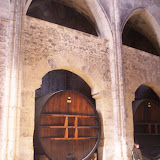
Originally Valmagne was founded under Benedictine order but, in 1159, the monks joined the Cistercian movement.During the Revolution in 1789, the last five monks fled just ahead of rebellious peasants who invaded and ransacked the abbey, burning precious documents, furniture and works of art. Confiscated as a national property, the abbey was sold in 1791 and turned into a wine cellar, by adding big vats in the nave. It has remained as such to this day.

The Abbaye is open to the public everyday for visits and wine tasting.