
 |
| Visit to L'Abbaye de Valmagne by Travel Med Tours |
Saturday, March 31, 2007
Photo Album of Valmagne
Have a look at some of the photos we took of the abbey while at the wine auction.

Friday, March 30, 2007
Wine Auction at L'Abbaye de Valmagne
 We had the opportunity to spend the afternoon at a wine auction in the Abbaye de Valmagne. It's about a 30 min. drive from Montpellier (France). For more than twenty years, the abbey stocks part of their yearly production in the monastery's cellar. Just recently we were invited to an auctioning of selected vintages between 1986 and 2001.
We arrived early to taste the wines presented which were their Cuvee Classic, from 1986 to 2001 and the Curvee de Turenne from 1994 to 2001. It was an enjoyable afternoon with cartoons of six bottles ranging between 40 to 150 euros. Definitely a great value!
To give you a brief bit of history; Abbaye de Valmagne is one of the best preserved examples of Cistercian art in France.The Abbaye de Valmagne was founded in 1138 by Raymond Trencavel. From the 12th to the 14th century, it was one of the richest abbeys in the south of France. Since the Revolution, the Abbey has served as a place to age the wines of Valmagne.
 Since 1985, the wines of Valmagne have received the AOC classification. The choice of grapes, limited production and the use of modern techniques have allowed these wines to achieve national and international notoriety.
In 1139 Raymond Trencavel, Viscount of Béziers founded the Abbey of Valmagne in the Parish of Villeveyrac, near the port of Mèze on the "Bassin de Thau". From the XII th to the XIII th century, Valmagne was one of the richest abbeys in South of France.
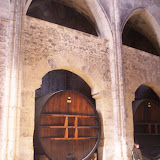
Originally Valmagne was founded under Benedictine order but, in 1159, the monks joined the Cistercian movement.During the Revolution in 1789, the last five monks fled just ahead of rebellious peasants who invaded and ransacked the abbey, burning precious documents, furniture and works of art. Confiscated as a national property, the abbey was sold in 1791 and turned into a wine cellar, by adding big vats in the nave. It has remained as such to this day.
The Abbaye is open to the public everyday for visits and wine tasting.
Subscribe to:
Comments (Atom)